Learn what Conductor SaaS is, where it fits in SEO and AEO workflows, how teams evaluate it, and what to check before a demo.
EasyGlobe Team
Global Growth Team
EasyGlobe helps teams expand into global markets with practical SEO, localization, LLM optimization, paid advertising, and growth operations. We turn complex international growth work into clear systems, high-quality content, and measurable execution.
Conductor SaaS is a software platform for teams that manage search visibility, content performance, AI answer visibility, and technical website health in one operating workflow. The current Conductor site describes its platform around AEO, SEO, content creation, monitoring, reporting, and agentic workflows rather than a single point SEO tool.
For a quick product context, start with the EasyGlobe directory page for Conductor. This guide goes deeper on what the platform is, which teams usually evaluate it, where it can fit, and what questions to ask before a demo.
What is Conductor SaaS?
Conductor SaaS is an enterprise oriented marketing and website optimization platform. In current public positioning, Conductor groups its platform into Conductor Intelligence, Conductor Creator, Conductor Monitoring, and Conductor AgentStack.
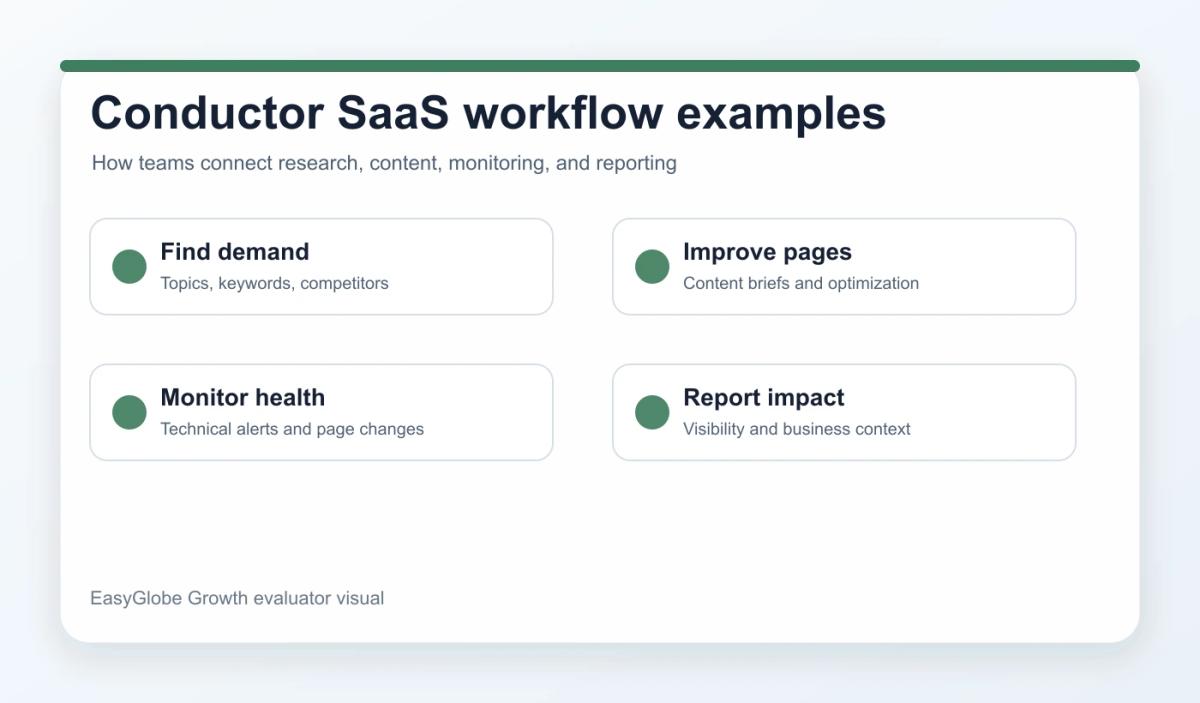
In plain terms, that means Conductor tries to connect four jobs that often sit in separate tools:
Researching topics, keywords, competitors, pages, and AI search visibility.
Creating and optimizing content with search and brand context.
Monitoring websites for technical and content issues.
Reporting on visibility, traffic, conversions, and business impact.
AEO means answer engine optimization. It is the work of making a brand easier to find and cite in AI answer systems, not only in classic search results. SEO still matters here because many of the same content, technical, and authority signals shape whether a website can be discovered, crawled, trusted, and used.
Who uses Conductor SaaS?
Conductor is most relevant for organizations where organic visibility is shared across several teams. A small founder can learn from its workflow model, but the platform is mainly positioned for enterprise teams and growing organizations with larger websites, many tracked topics, and cross-functional ownership.
Typical users include:
SEO and organic growth teams that need keyword, page, competitor, and AI search visibility data.
Content marketing teams that need briefs, optimization guidance, and a way to connect content work to performance.
Web, ecommerce, and technical SEO teams that need monitoring, alerts, and audit trails for site changes.
Marketing leaders who need reporting that connects visibility work to traffic, conversion, and revenue context.
The Conductor pricing page currently names Essentials, Growth, and Enterprise plan levels, but it does not present simple public dollar pricing. Treat that as a buying signal: teams should confirm plan limits, usage units, included products, and contract terms directly with Conductor before making budget assumptions.
What practical examples show the fit?
A practical workflow starts when a team needs more than a keyword list. The team may need to know which topics matter, which pages already rank, which competitors own answer visibility, and which technical issues might block progress.
Example 1 is an SEO team planning a quarter of content updates. The team could use Conductor Intelligence for demand and competitor context, then use Conductor Creator to build or improve content briefs. The output should not be "publish more pages" by default. It should be a ranked work queue with page owners, target topics, internal links, and a way to measure results.
Example 2 is a content team trying to improve an existing library. A useful workflow is to group pages by business priority, compare coverage gaps, update the pages that can realistically win, and track movement in search and AI answer visibility. This fits EasyGlobe's broader SEO optimization work because content changes need technical and measurement follow-through.
Example 3 is a web team protecting high-value templates. Conductor Monitoring is positioned around always-on website monitoring, alerts, page element tracking, and audit trails. That can matter when product pages, legal copy, metadata, internal links, or JavaScript changes affect search visibility.
How should teams evaluate Conductor SaaS?
Evaluate Conductor against the way your team already works. The main question is not whether the product has many features. The question is whether it can become the operating layer for search, content, AEO, and technical health decisions.
Use this sequence:
List the current tools used for keyword research, content briefs, rank tracking, analytics, technical audits, and reporting.
Identify where data is duplicated, manually exported, or ignored because the workflow is too slow.
Pick three high-value use cases, such as updating a content hub, protecting ecommerce pages, or tracking AI search visibility for a core category.
Ask Conductor to demonstrate those exact use cases with your team structure in mind.
Compare the demo output against your current stack, not against a generic feature checklist.
Google Search Console should still be part of the evaluation. Google's Performance report explains clicks, impressions, CTR, average position, queries, pages, countries, devices, and dates. A paid platform should make that data more actionable, not replace the need to understand the source metrics.
What are the limits and risks?
The biggest limit of Conductor SaaS is that a platform cannot fix unclear ownership. If SEO owns reporting, content owns publishing, engineering owns templates, and leadership owns budget, the buying team needs a shared workflow before any tool can help.
Watch for these risks during evaluation:
Buying for one feature while paying for a broader enterprise platform.
Assuming public plan names are enough to estimate cost.
Tracking too many keywords or pages without a decision process.
Using AI content features without editorial review, brand standards, and source checks.
Treating monitoring alerts as useful before assigning owners and response rules.
Comparing Conductor only to point tools when the real decision is platform consolidation.
There is also a fit risk for very small sites. If you only publish a few pages, have no dedicated SEO owner, and do not need enterprise reporting, a simpler stack may be enough. If your team is expanding across markets, languages, ecommerce pages, content libraries, or AI search monitoring, the case for an integrated platform becomes stronger.
What should you ask before a demo?
Use the demo to test real workflow fit. Ask specific questions that force clear answers and avoid vague feature claims.
Good questions include:
Which Conductor products are included in the plan we are discussing?
What are the limits for pages analyzed, tracked keywords, tracked competitors, monitored pages, writing assistant drafts, and AI search credits?
Which analytics, CMS, data warehouse, and workflow tools can connect to our setup?
How does Conductor separate SEO visibility, AI answer visibility, content recommendations, and technical monitoring?
What permissions, approvals, audit logs, and reporting controls are available for larger teams?
How often are important data sets refreshed, and which metrics are first-party, third-party, or imported?
What does onboarding require from SEO, content, analytics, engineering, and legal teams?
If your team is also evaluating AI search work, compare the answers against your LLM optimization priorities. For directory research and adjacent software comparisons, EasyGlobe's SaaS directory can help map alternatives before you commit to a sales process.
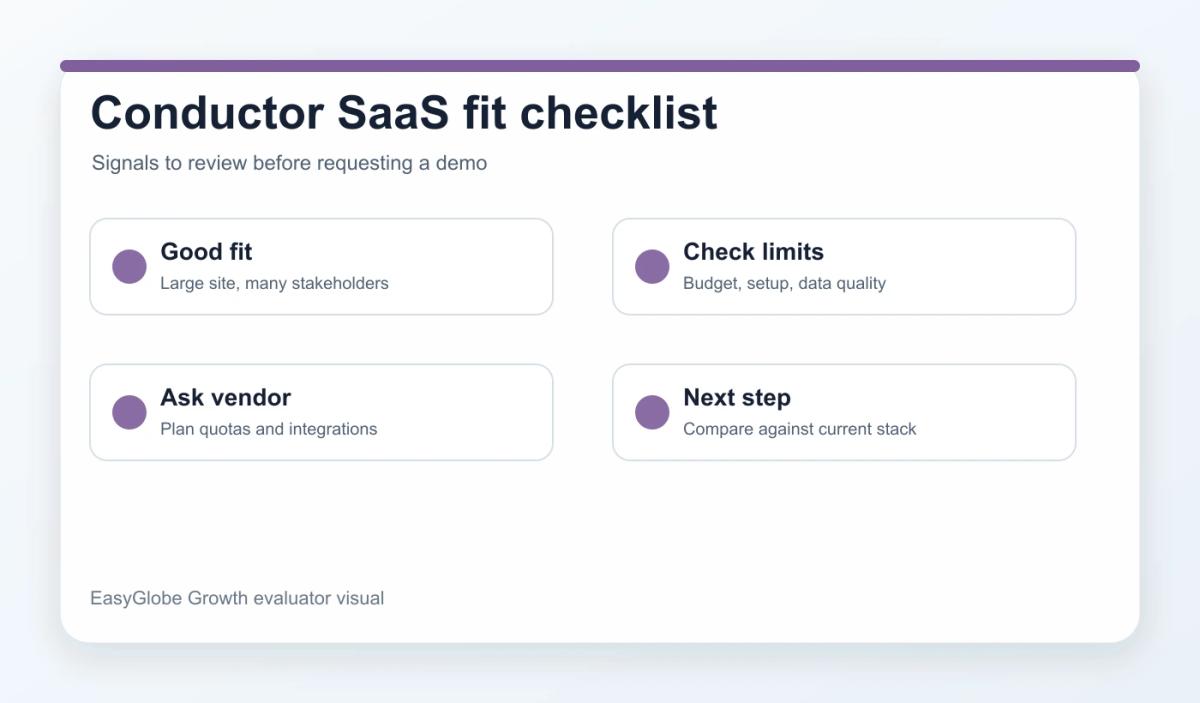
When is Conductor SaaS a good fit?
Conductor SaaS is a good fit when search, AI visibility, content operations, technical site health, and reporting need to be managed together. It is especially relevant when the team has enough website scale and stakeholder complexity to justify an enterprise workflow.
Positive fit signals include:
A content library where refresh decisions matter as much as new publishing.
Many templates, regions, product pages, or brand pages that need monitoring.
Multiple teams asking for the same visibility data in different formats.
Leadership pressure to show how SEO and AEO work connect to business outcomes.
A need to reduce exports, disconnected dashboards, and manual reporting.
Weak fit signals include a tiny site, no content roadmap, no analytics baseline, or a buyer who only wants a low-cost keyword tracker. In those cases, begin with clean Search Console reporting, page quality improvements, internal linking, and technical hygiene before evaluating a large platform.
What should readers do next?
First, read the current official Conductor platform and pricing pages. Public pages can change, so confirm product names, plan limits, and eligibility directly with Conductor.
Second, write down three jobs your team wants Conductor SaaS to improve. Keep them concrete: "prioritize 50 content refreshes," "monitor 20,000 product pages," or "report AI answer visibility for five buying categories" is more useful than "improve SEO."
Third, compare the answer to your current operating model. A platform is worth evaluating when it reduces decision friction, improves source-backed prioritization, and gives owners a clearer next action.
FAQ
Is Conductor SaaS only an SEO tool?
No. Conductor still covers SEO workflows, but its current positioning also includes AEO, AI search visibility, content creation, website monitoring, reporting, APIs, and agent workflows.
Does Conductor publish public pricing?
Conductor publishes plan names and capability limits on its pricing page, but the current public page does not show simple dollar prices. Confirm pricing and plan terms directly with Conductor.
Is Conductor SaaS right for a small website?
Maybe, but it is usually easier to justify for larger sites, content programs, ecommerce catalogs, or teams with several stakeholders. Small sites should prove the workflow need first.
What data should I prepare before evaluating Conductor?
Prepare Search Console performance data, analytics goals, priority page groups, current content workflow notes, technical SEO pain points, and the list of tools you may replace or keep.
Sources
Conductor platform overview for current product positioning around Creator, Intelligence, Monitoring, and AgentStack.
Conductor pricing page for current plan names, plan positioning, and public usage limit examples.